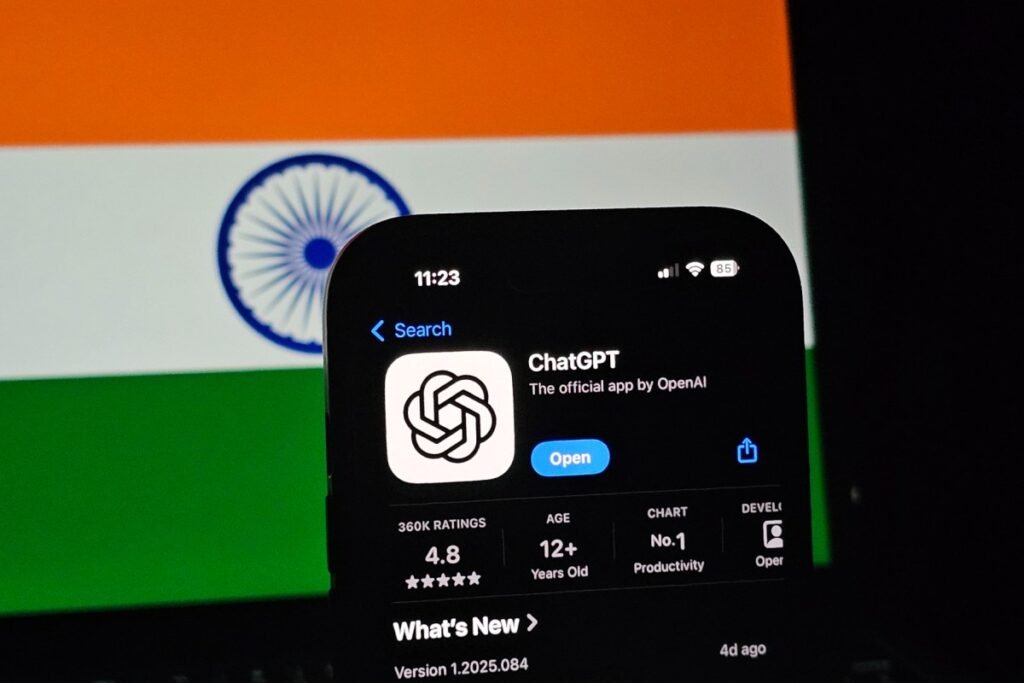
India has 100 million weekly active ChatGPT users, making the country one of OpenAI’s largest markets globally, CEO Sam Altman said ahead of a government-hosted AI summit.
On Sunday, Altman outlined ChatGPT’s growing adoption in India in an articlepublishedin the Indian English daily Times of India, as OpenAI prepares to formally participate in the five-day India AI Impact Summit in New Delhi, beginning Monday. Altman isattending the eventalongside senior executives from several of the world’s leading AI companies.
The growth comes as OpenAI,like other leading AI firms, looks to India’s young population and its more than a billion internet users to fuel global expansion. The ChatGPT makeropened a New Delhi officein August 2025 after months of groundwork in the country, and has adjusted its approach for India’s price-sensitive market, including rolling out asub-$5 ChatGPT Go tierthat waslater made free for a yearfor Indian users.
In the article, Altman said India is ChatGPT’s second-largest user base after the United States, highlighting the South Asian nation’s growing weight in OpenAI’s global strategy. The disclosure comes as ChatGPT’s overall usage has surged worldwide, with the platformreaching 800 million weekly active usersas of October 2025 and reported to beapproaching 900 million.
Altman also highlighted the role of students in driving adoption, saying India has the largest number of student users of ChatGPT globally.
Indian students have become a key growth segment for leading AI companies more broadly, as rivals race to embed their tools in classrooms and learning workflows. Google has similarly targeted the market, offering Indian students afree one-year subscription to its AI Pro planin September 2025. Separately, India accounts for thehighest global usage of Gemini for learning, Chris Phillips, Google’s vice president and general manager for education, said last month.
“With its focus on access, practical Al literacy, and the infrastructure that supports widespread adoption, India is well positioned to broaden who benefits from the technology and to help shape how democratic AI is adopted at scale,” Altman wrote.
ChatGPT’s rapid growth also highlights a broader challenge for AI companies in India: translating widespread adoption into sustained economic impact. Indian government initiatives such as the IndiaAI Mission — a national program aimed at expanding computing capacity, supporting startups and accelerating AI adoption in public services — seek to address those gaps. However, the country’s price-sensitive market and infrastructure constraints have made monetization and large-scale deployment more complex than in developed economies.
“Given India’s size, it also risks forfeiting a vital opportunity to advance democratic AI in emerging markets around the world,” Altman wrote, warning that uneven access and adoption could concentrate AI’s economic gains in too few hands.
Altman also signaled that OpenAI plans to deepen its engagement with the Indian government, writing that the company would soon announce new partnerships aimed at expanding access to AI across the country. He did not provide details, but said the focus would be on widening reach and enabling more people to put AI tools to practical use.
TheIndia AI Impact Summitis expected to draw a wide cross-section of global technology and political leaders, including Anthropic CEO Dario Amodei, Sundar Pichai of Google, and senior Indian business figures such as Mukesh Ambani and Nandan Nilekani. Political leadersincludingEmmanuel Macron, Sheikh Khaled bin Mohamed bin Zayed Al Nahyan, and Luiz Inácio Lula da Silva are also expected to attend, spotlighting India’s ambition to position itself as a central player in global AI debates.
For global AI firms, including OpenAI, the summit underscores how India’s vast user base is translating into growing influence over how the technology evolves.
Source: Techcrunch