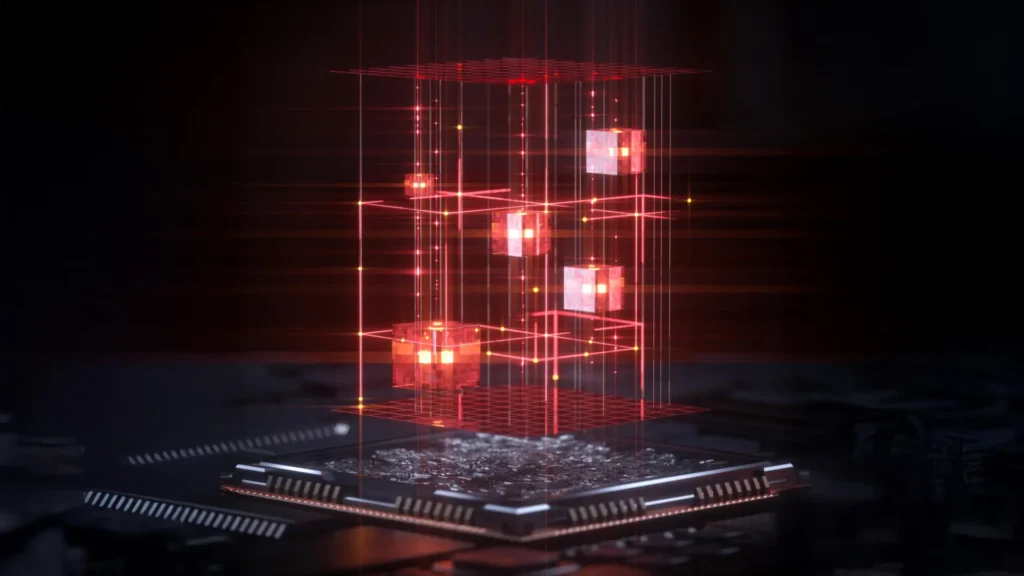
A single beam of light runs AI with supercomputer power
Light-based tensor computing could push AI into a new era of ultra-fast, energy-efficient performance.
Tensor operations are a form of advanced mathematics that support many modern technologies, especially artificial intelligence. These operations go far beyond the simple calculations most people encounter. A helpful way to picture them is to imagine manipulating a Rubik's cube in several dimensions at once by rotating, slicing, or rearranging its layers. Humans and traditional computers must break these tasks into sequences, but light can perform all of them at the same time.
Today, tensor operations are essential for AI systems involved in image processing, language understanding, and countless other tasks. As the amount of data continues to grow, conventional digital hardware such as GPUs faces increasing strain in speed, energy use, and scalability.
Researchers Demonstrate Single-Shot Tensor Computing With Light
To address these challenges, an international team led by Dr. Yufeng Zhang from the Photonics Group at Aalto University's Department of Electronics and Nanoengineering has developed a fundamentally new approach. Their method allows complex tensor calculations to be completed within a single movement of light through an optical system. The process, described as single-shot tensor computing, functions at the speed of light.
"Our method performs the same kinds of operations that today's GPUs handle, like convolutions and attention layers, but does them all at the speed of light," says Dr. Zhang. "Instead of relying on electronic circuits, we use the physical properties of light to perform many computations simultaneously."
Encoding Information Into Light for High-Speed Computation
The team accomplished this by embedding digital information into the amplitude and phase of light waves, transforming numerical data into physical variations within the optical field. As these light waves interact, they automatically carry out mathematical procedures such as matrix and tensor multiplication, which form the basis of deep learning. By working with multiple wavelengths of light, the researchers expanded their technique to support even more complex, higher-order tensor operations.
"Imagine you're a customs officer who must inspect every parcel through multiple machines with different functions and then sort them into the right bins," Zhang says. "Normally, you'd process each parcel one by one. Our optical computing method merges all parcels and all machines together — we create multiple 'optical hooks' that connect each input to its correct output. With just one operation, one pass of light, all inspections and sorting happen instantly and in parallel."
One of the most striking benefits of this method is how little intervention it requires. The necessary operations occur on their own as the light travels, so the system does not need active control or electronic switching during computation.
"This approach can be implemented on almost any optical platform," says Professor Zhipei Sun, leader of Aalto University's Photonics Group. "In the future, we plan to integrate this computational framework directly onto photonic chips, enabling light-based processors to perform complex AI tasks with extremely low power consumption."
Zhang notes that the ultimate objective is to adapt the technique to existing hardware and platforms used by major technology companies. He estimates that the method could be incorporated into such systems within 3 to 5 years.
"This will create a new generation of optical computing systems, significantly accelerating complex AI tasks across a myriad of fields," he concludes.
The study was published inNature Photonicson November 14th, 2025.
- RELATED TOPICS Computers & Math Computers and Internet Artificial Intelligence Computer Modeling Spintronics Research Computer Science Distributed Computing Information Technology Mathematics
- Computers & Math Computers and Internet Artificial Intelligence Computer Modeling Spintronics Research Computer Science Distributed Computing Information Technology Mathematics
- Computers and Internet
- Artificial Intelligence
- Computer Modeling
- Spintronics Research
- Computer Science
- Distributed Computing
- Information Technology
- RELATED TERMS Quantum computer Gross domestic product Robot Artificial intelligence Scientific visualization Computing Introduction to quantum mechanics Scientific method
- Quantum computer
- Gross domestic product
- Artificial intelligence
- Scientific visualization
- Introduction to quantum mechanics
- Scientific method
Materials provided byAalto University.Note: Content may be edited for style and length.
- Yufeng Zhang, Xiaobing Liu, Chenguang Yang, Jinlong Xiang, Hao Yan, Tianjiao Fu, Kaizhi Wang, Yikai Su, Zhipei Sun, Xuhan Guo. Direct tensor processing with coherent light. Nature Photonics, 2025; DOI: 10.1038/s41566-025-01799-7
Scientists Discover Ancient “Level 7” Super-Predator That Would Have Snacked on Killer Whales Today
After 2,000 Years, Scientists Finally Solve the Riddle of the Chameleon’s Wandering Eye
Satellites Spot 115 Foot “Monster” Waves From Pacific Megastorm
Source: Sciencedaily